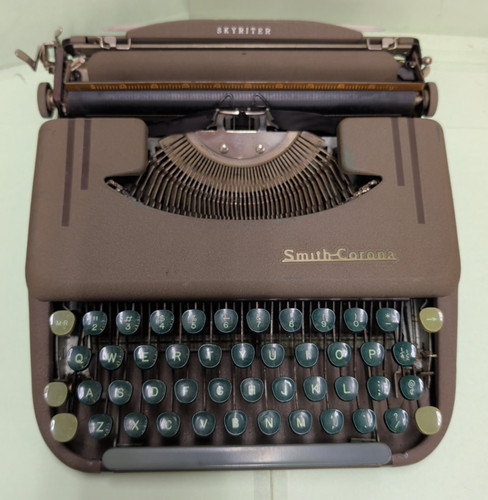
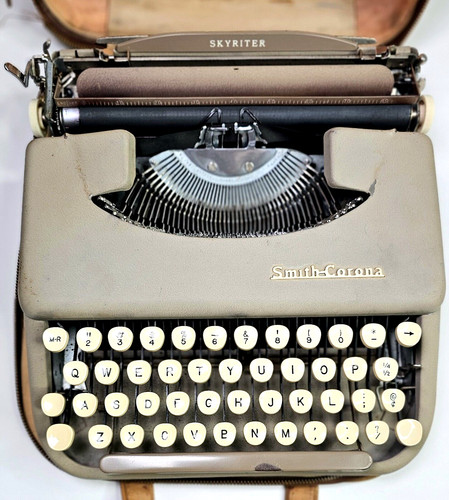
Smith-Corona named the Skyriter for the new age of air travel, and it's small, flat and light enough to fly with. It launched in 1949 as a redesign of the prewar Zephyr. Ted Munk's research splits it into three series, the 2Y (1949–56), the 3Y (mid-1956 to about 1959) and the 4Y (1960–62), when production moved to England. The Corsair replaced it in the mid-1960s. Early ones are brown crinkle with stripes, and later ones are tan or gray. The action is stiffer than a Hermes Baby's. That's the design, and it isn't a fault. About 16 were on eBay in late 2026 at roughly $130–230 delivered, and many were described as working but needing a tune-up. Plan on that tune-up, and pick an established seller over a slightly lower price.
Specifications
Brand
Smith-Corona
Type
Ultra-portable
Era
1950s
Years produced
1949–early 1960s
Country of manufacture
USA (England from 1960)
Carriage width
Compact carriage
Pitch options
Pica, Elite
Ribbon spool
Small 1⅝-inch Smith-Corona spools
Typical asking price (eBay, Oct 20, 2026)
$120 – $250
Buying guide
Which one to buy
From Oct 20, 2026 listings
The Skyriter is small, flat and light enough to fly with, and its stiff action is how it was built. Our pick is the 1960 England-built one, working with its case, at $126 delivered. Most ask $120–250. Plan on a tune-up for most, ask whether the original small 1⅝-inch spools come with it, and compare photos where titles are copied word for word.
Delivered prices include shipping as eBay quoted it to a US address on Oct 20, 2026. Many sellers charge by distance, so your total may differ. eBay shows yours before you pay.
Snapshot
For sale on eBay
8 of 100 listed
Checked . Some may have sold.
Delivered prices include shipping as eBay quoted it to a US address on Oct 20, 2026. Many sellers charge by distance, so your total may differ. eBay shows yours before you pay.
It takes small 1⅝-inch ribbon spools, not standard 2-inch ones, so keep the originals or buy ribbon made for the Skyriter. Most machines want a tune-up, and the stiff action is normal.
Spools: Ask the seller whether the original small spools come with it. If not, buy ribbon made for the Skyriter.
Case and catches: Look closely at the thin metal case and its catches in the photos. The catches should close and hold the lid.
Carriage return: On arrival, throw the return lever a few times. The carriage should come back fully and advance one line each time.
Platen: Ask the seller for a line of typed text. Faint or uneven letters usually mean a hard platen.
Copied listings: Compare the photos with any other listing that has the same title. This model had an unusual number of copied listings in our snapshot, so buy from established sellers.
What eBay’s condition grades mean on a typewriter
The machines here are 50 to 80 years old, so a condition badge means something different than it does on a two-year-old gadget. Here’s how to read them.
New
New or new old stock
Rare on a manual typewriter, since most are 50 or more years old. A “new” listing usually means a late machine still in its carton, like a late Olivetti Lettera 32, or a seller using the wrong badge. Look for the original packaging and factory ribbon spool in the photos. Without them, don't pay extra for the badge.
Refurbished
Refurbished or serviced
A typewriter specialist has given it a CLA (clean, lubricate and adjust). That usually means the segment re-lubed, the platen tested or re-covered, the drawband re-tensioned, the type slugs cleaned and the key linkages freed. Expect to pay $100–250 more than for the same machine unserviced, and look for the shop's name (Gramercy, Cambridge, WordsAreWinged and others) or a service receipt in the listing. It's the safest buy if you want to type the day it arrives.
Used
Used, tested and working
The best most listings get. It types, the carriage returns, the escapement advances, the shift works and the ribbon moves. Cosmetic wear is normal. “Tested with fresh ribbon” is best, “types all letters” is fine, and a stated return window helps. Anything vaguer is closer to “for parts.” The platen rubber is often still hard on a tested machine, so budget $150–250 for a re-cover if you'll type long pieces on it.
For parts
For parts or not working
Listed as-is, with no promise it works. The usual faults on a project machine are a hard platen, a gummed segment (sticky keys), a broken drawband, a missing case, a broken bell and dirty type slugs. Buy one for spare parts, or only if you're ready to add a $100–300 specialist CLA. A tested used machine almost always costs less than a parts machine plus a service bill.
Accessories on Amazon
A machine off eBay almost never comes with a fresh ribbon, a brush, platen fluid or oil. The ribbon search is for this machine’s spool (Small 1⅝-inch Smith-Corona spools). The wrong spool is the easiest way to buy a ribbon you can’t use.
Series dates come from Ted Munk's Skyriter survey (typecast.munk.org). Production years are approximate, pulled from collector references (the Typewriter Database, oz.Typewriter, and Ted Munk's and Richard Polt's typewriter pages). To date a machine, look its serial number up on the Typewriter Database's page for the brand, and don't trust a seller's stated year.


 Used