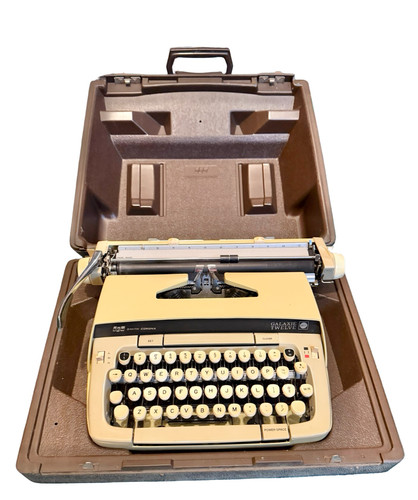
One serviced Smith-Corona Galaxie was listed for only about $97 in late 2026, which shows how plentiful they are. About 30 were on eBay, at roughly $95–170 delivered, so you never need to overpay. The Galaxie began Smith-Corona's US-made 6-series in 1960, styled by David Chase and Philip Stevens, and the same angular body was sold under several names, including Sterling, Super-Sterling and Deville. The 1960s Galaxie and Galaxie Deluxe have all-metal bodies. The Galaxie II came next, and the 1970s Galaxie Twelve, with its wider carriage, is the version you'll see most. They're solid portables and easy to live with. Earlier Galaxies, the Galaxie II, and colors like red and two-tone blue ask more. To type every day, a serviced or tested one near the bottom of the range does the job.
The 1970s Galaxie Twelve is the common version, and there are enough Galaxies for sale that you never need to overpay. Most ask $100–110 delivered, and working ones start under $90 before shipping. The all-metal 1960s Galaxie, the Galaxie II and bright colors ask a little more. The plastic case latches break, so check them in the photos, and judge the platen from a typed line.
Delivered prices include shipping as eBay quoted it to a US address on Oct 19, 2026. Many sellers charge by distance, so your total may differ. eBay shows yours before you pay.
Snapshot
For sale on eBay
8 of 30 listed
Checked . Some may have sold.
Delivered prices include shipping as eBay quoted it to a US address on Oct 19, 2026. Many sellers charge by distance, so your total may differ. eBay shows yours before you pay.
Used
★ Cheapest
Nice Vintage Smith Corona Portable Galaxie Typewriter & Case W/ KEY! Works Great
$89.00+ shipping
$89.00 · shipping not stated
Buy It Now$89.00
Offers accepted+
This seller takes offers, and many sellers accept less than the asking price.
Fine if you might miss it? Send an offer first. Someone else can still buy it while you wait for a reply.
The plastic case latches break, and later machines use more plastic trim that can crack. With so much supply, skip anything untested unless it's very cheap.
Case latches: Look at the plastic case latches in the photos. They should be whole and hold the lid shut.
Ribbon: On arrival, type a few lines and watch the ribbon. The vibrator should lift cleanly, and the ribbon should reverse at the end of the spool.
Carriage return: Throw the return lever a few times. The carriage should come back fully and advance the paper one line each time.
Platen: Ask the seller for a line of typed text. Faint or uneven letters usually mean a hard platen.
Plastic trim: Check the knobs and covers in the photos. Look for cracks, especially on later machines.
What eBay’s condition grades mean on a typewriter
The machines here are 50 to 80 years old, so a condition badge means something different than it does on a two-year-old gadget. Here’s how to read them.
New
New or new old stock
Rare on a manual typewriter, since most are 50 or more years old. A “new” listing usually means a late machine still in its carton, like a late Olivetti Lettera 32, or a seller using the wrong badge. Look for the original packaging and factory ribbon spool in the photos. Without them, don't pay extra for the badge.
Refurbished
Refurbished or serviced
A typewriter specialist has given it a CLA (clean, lubricate and adjust). That usually means the segment re-lubed, the platen tested or re-covered, the drawband re-tensioned, the type slugs cleaned and the key linkages freed. Expect to pay $100–250 more than for the same machine unserviced, and look for the shop's name (Gramercy, Cambridge, WordsAreWinged and others) or a service receipt in the listing. It's the safest buy if you want to type the day it arrives.
Used
Used, tested and working
The best most listings get. It types, the carriage returns, the escapement advances, the shift works and the ribbon moves. Cosmetic wear is normal. “Tested with fresh ribbon” is best, “types all letters” is fine, and a stated return window helps. Anything vaguer is closer to “for parts.” The platen rubber is often still hard on a tested machine, so budget $150–250 for a re-cover if you'll type long pieces on it.
For parts
For parts or not working
Listed as-is, with no promise it works. The usual faults on a project machine are a hard platen, a gummed segment (sticky keys), a broken drawband, a missing case, a broken bell and dirty type slugs. Buy one for spare parts, or only if you're ready to add a $100–300 specialist CLA. A tested used machine almost always costs less than a parts machine plus a service bill.
Accessories on Amazon
A machine off eBay almost never comes with a fresh ribbon, a brush, platen fluid or oil. The ribbon search is for this machine’s spool (Group 1 universal). The wrong spool is the easiest way to buy a ribbon you can’t use.
Ribbon, Group 1 universal (most postwar portables)
Smith-Corona badged the same body under several model names. Production years are approximate, pulled from collector references (the Typewriter Database, oz.Typewriter, and Ted Munk's and Richard Polt's typewriter pages). To date a machine, look its serial number up on the Typewriter Database's page for the brand, and don't trust a seller's stated year.



 Used


